
ITSCI is deeply saddened by the reported mine collapse in the Rubaya area which has cost the lives of hundreds of artisanal miners. This accident highlights the heightened safety risks that can be associated with informal artisanal and small‑scale mining, where sites operate outside due diligence systems and responsible sourcing frameworks.
Luwowo mine site is located near Rubaya town, on a concession formerly known as PE4731 and where ITSCI has not operated since December 2018 (see Annex 1 for more details on locations). More broadly, ITSCI’s due diligence, monitoring and stakeholder support activities as well as tagging by Congolese state services have been suspended in Masisi territory since early 2023 due to the deteriorating security situation linked to the presence of the non‑state armed group M23/AFC (see Annex 2 for a detailed chronology on suspension and resumptions of activities in Masisi territory).
Accidents at artisanal mine sites are not inevitable. When ITSCI supported activities on the ex-PE4731 between 2014-2018, including at the Luwowo mine, we worked jointly with SAEMAPE (the Service for Assistance and Supervision of Artisanal and Small‑Scale Mining) and mining operators to monitor Occupational Health and Safety (OHS) risks, and jointly implement concrete safety mitigation measures. These included, for example, authorities prohibiting underground mining at certain mines, constructing mining terraces to prevent landslides, as well as OHS awareness-raising and capacity building activities. These actions, which go beyond the scope of the OECD Guidance, had a positive impact to prevent the occurrence, and reduce the number, of OHS accidents at the mines and contributed to improved and safer mining practices.
After years of joint efforts by ITSCI, governments, industry, and other stakeholders, it is regrettable to witness such a setback, and its consequences for local mining communities.
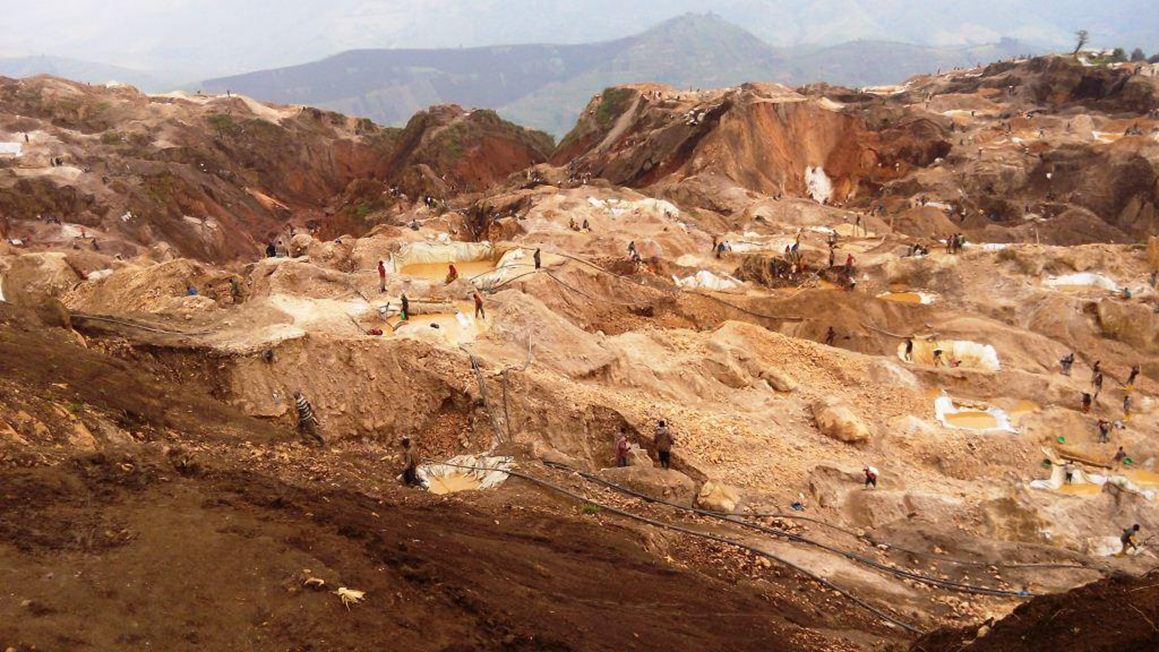
Area of Luwowo mine that switched from underground to open-pit mining following interventions from ITSCI and state services. January 2017.
The prolonged suspension of ITSCI monitoring and tagging by state services in Masisi territory due to the presence of non-state armed groups has also had wider implications, including increased risks in safety hazards, illegal taxation, and mineral fraud. In this context, ITSCI has previously published a statement on tantalum mineral flows from the Great Lakes Region, including data relating to material traded outside the ITSCI Programme, to help stakeholders understand how insecurity and the suspension of traceability, due diligence and state oversight can lead to heightened risks and discrepancies between production, export, and international trade figures.
This statement supports responsible sourcing and companies’ due diligence by highlighting the limitations of data in conflict‑affected settings, the heightened risks when traceability, due diligence and monitoring mechanisms cannot operate, as well as actions undertaken by ITSCI to address those risks.
ITSCI hopes that the recent peace agreement between the DRC and Rwanda and ongoing discussions between those countries as well as between the DRC government and M23/AFC will result in sustained peace and stability, enabling the resumption of formalisation efforts for artisanal mining in Masisi territory.
ITSCI activities, including tagging by Congolese state services, currently continues in other areas including Walikale territory of North Kivu Province, as well as in other provinces of the Democratic Republic of Congo (Haut-Katanga, Haut-Lomami, Lualaba, Maniema, South Kivu, Tanganyika and Tshopo Province).
-END-
Annex 1. Clarification about the location of the accident
- What is sometimes referred to as the “Rubaya mine” corresponds to a concession formerly covered by exploitation permit PE 4731 of company Société Minière de Bisunzu Sarl (SMB). Luwowo mine, where the accident took place, is located on that concession.
- SMB participated in ITSCI from 2014 until December 2018 and during that time ITSCI monitored activities on that concession.
- Rubaya is the name of a trading town located nearby.
- Prior to suspension due to the presence of non-state armed group M23/AFC (see Annex 2 below), ITSCI was present in Masisi territory, including Rubaya town, but excluding ex-PE4731, to support mineral traceability and due diligence.
Annex 2. Notes on suspension in Masisi territory
Suspension of ITSCI activities is not a process specific to North Kivu or the current situation. As a facilitation initiative, we have for the past 15 years worked on the implementation of the OECD Guidance in Conflict-Affected and High-Risk Areas, achieved through cooperative engagement with local, national and international stakeholder, and follow clear guidelines on the risks of armed group interference. Suspending ITSCI tagging may be necessary when risks cannot be mitigated and disengagement is the only appropriate action, in alignment with the recommendations of the OECD Guidance. Such process is coordinated with local governments responsible for implementing traceability.
Since early 2023, ITSCI’s operations in Masisi territory, North Kivu Province, have been repeatedly and predominantly suspended due to the volatile security situation, including the presence and movements of the non‑state armed group M23 in and around Rubaya town. These developments resulted in the withdrawal of ITSCI field teams and the suspension of tagging and monitoring activities by Congolese state services across Masisi territory:
- ITSCI suspended in Masisi territory following the presence of non-state armed group M23 in Rubaya town (March 2023)
- ITSCI tagging resumes in Masisi territory, North Kivu Province, DRC (May 2023)
- Suspension of the ITSCI Programme in Masisi territory, North Kivu (DRC) for security reasons related to the non-state armed group M23 (December 2023)
- ITSCI resumes in Masisi territory following positive security developments (April 2024)
- Suspension of ITSCI activities in Masisi territory following the presence of non-state armed group M23 in Rubaya town (May 2024)
ITSCI is committed to record and follow-up all information received regarding supply chain risks and encourages all parties to use our whistleblowing programme to report any risks or incidents, for us to continue reporting and advocating for appropriate actions. The ITSCI whistleblowing procedure and contact details are available online at www.itsci.org/contact/. The confidential ITSCI whistleblowing address is [email protected].