
ITSCI Export Figures vs. International Trade Data: What the Numbers Reveal
This update is provided to support stakeholder understanding of major changes in tantalum concentrate trade flows from the Great Lakes Region unrelated to ITSCI activities, and to inform stakeholders of our ongoing efforts to closely follow and act on mineral plausibility questions as relevant to our operations. We remain committed to providing accurate, first-hand data and addressing misconceptions that may arise from generalised reporting or misinterpretation of trade statistics.
High risks of mineral fraud due to ongoing insecurity in the DRC
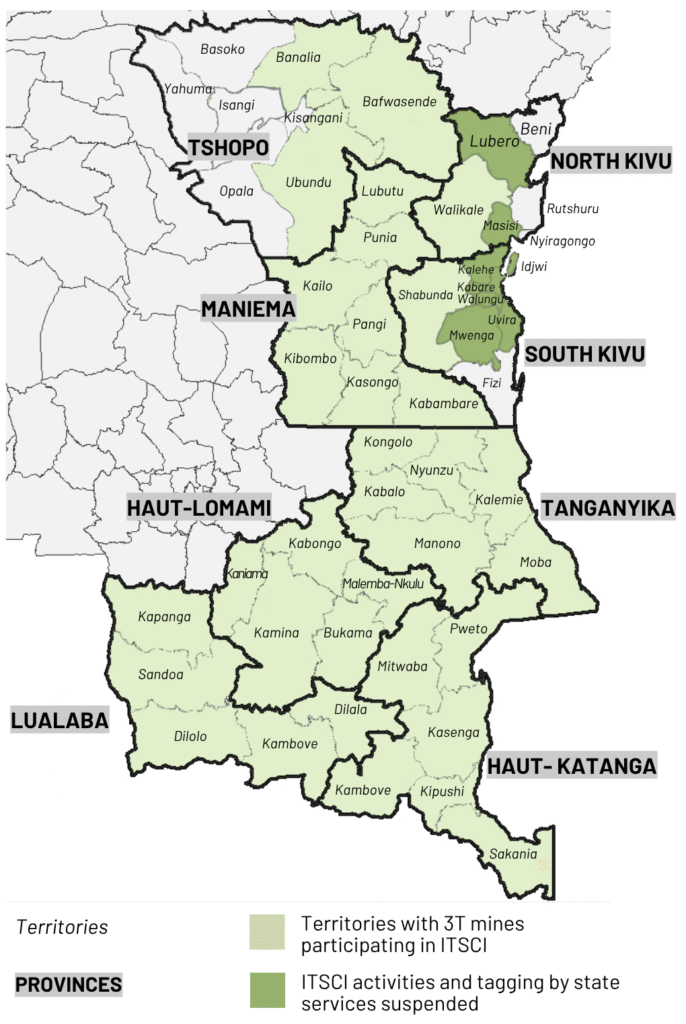
Despite the peace agreement between the DRC and Rwanda and ongoing efforts to progress, the situation in Eastern DRC remains precarious and complex. ITSCI activities remain suspended in large parts of North and South Kivu Provinces, including the coltan-rich Masisi territory, due to the ongoing presence of the non-state armed group M23/AFC, among others. Nevertheless, ITSCI is able to safely and credibly continue operations in selected areas of both provinces – and beyond, in other provinces of the DRC – that remain under DRC government control. A geographical overview provided.
Clashes persist between M23/AFC on the one side, and FARDC and their allies from various Wazalendo factions, on the other; although sometimes with reported clashes between and/or among Wazalendo factions and FARDC. ITSCI deplores the humanitarian impact, including displacement and human rights abuses against local civilian populations. This situation undermines ITSCI’s longstanding efforts to encourage effective due diligence and responsible trade in the mining sector and creates ongoing high risks of mineral fraud to neighbouring areas, including Rwanda.
Growing divide: ITSCI data and Rwanda’s expanding mineral trade flows
For the year of 2024, tantalum concentrate exports from Rwanda recorded in the ITSCI system totalled 2,354 tonnes, marking a 14% variation (+296 tonnes) compared to 2023. This is among the lowest change in recent years and within typical year-on-year variations[1]. Preliminary 2025 data shows that recorded ITSCI tantalite exports from Rwanda have remained stable, at 1,078 tonnes for the period January-June 2025, compared to 1,225 tonnes for the same period in 2024 (an approximate 12% decrease).
In contrast, international trade databases[2] report significantly higher figures of world tantalum imports from Rwanda[3]:
- For 2024, the volume of tantalum imports from Rwanda exceeds 2,900 tonnes, representing a ~52% increase (equivalent to approx. 1,000 tonnes) compared to 2023.
- Data for the period January-June 2025 shows a sharp increase, reaching 3,839 tonnes, or a 213% increase compared to the same period in 2024.
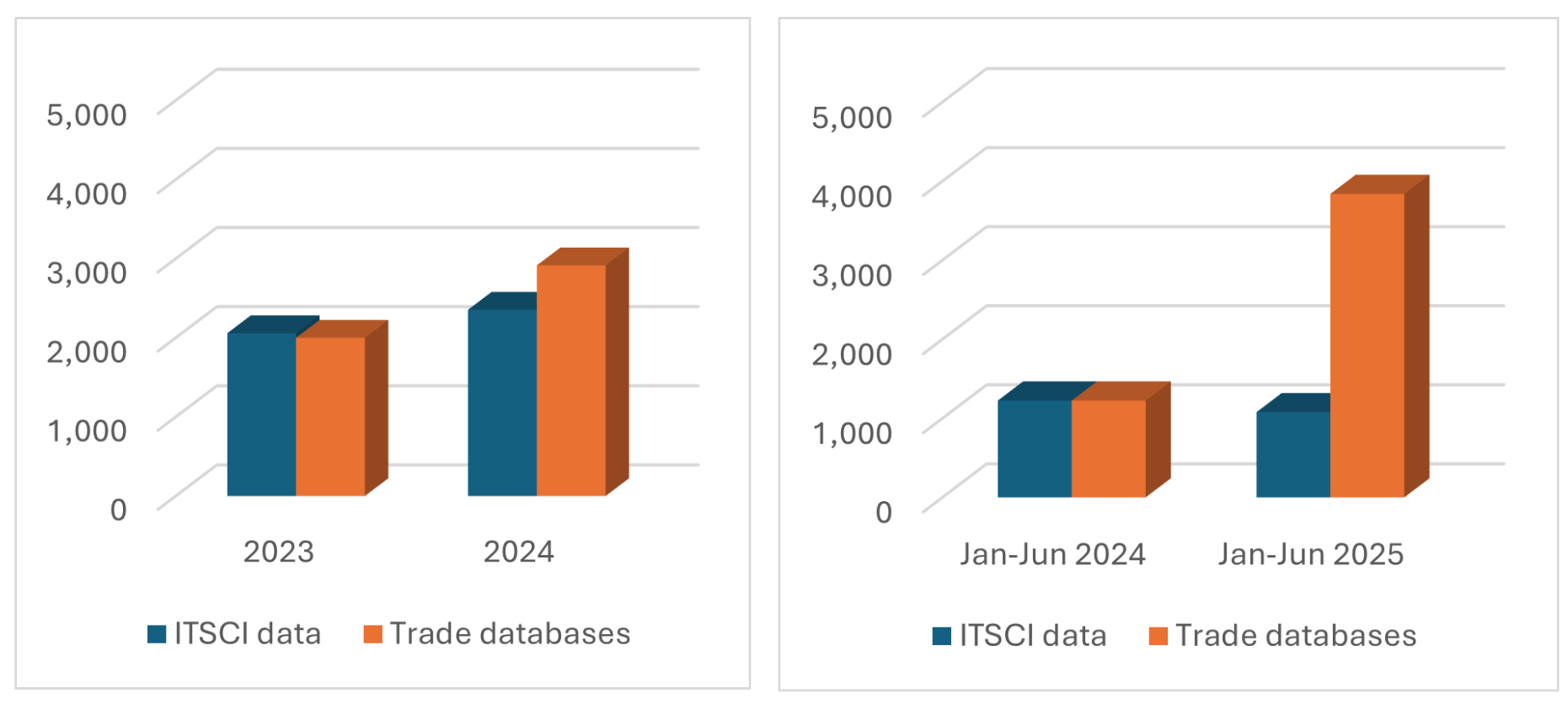
When considering any data, it is critical to understand its scope. It is notable that not all 3T operators in the Great Lakes Region participate in ITSCI and ITSCI does not report on non-ITSCI tonnages. In recent months in Rwanda, it has been widely reported that companies are adopting their own due diligence concepts or relying on other traceability systems at all stages of the upstream supply chain (mine, processor, exporter, and smelter). As the above data clearly demonstrates, mineral trading recorded by ITSCI does not represent the entirety of world tantalum import from Rwanda. Any stakeholder assumption that all tantalum exports from Rwanda fall under ITSCI traceability records is incorrect.
Data for 2025 is preliminary and incomplete. ITSCI continues to monitor and assess updated available information on a regular basis.
[1] It is not unusual for mineral exports from any area to increase or decrease by 20-30% in a year, and sometimes much more, due to multiple factors (pricing, licence regulations, or other factors).
[2] Including the publicly available UN Comtrade and the World Bank’s World Integrated Trade Solution.
[3] Import trade data may include a portion of warehousing.
ITSCI actions to address high plausibility risks in mineral supply chains in Rwanda
ITSCI applies a range of pro-active measures to understand and address persistent risks of mineral fraud in the Great Lakes Region, whether internal domestic or cross-border fraud from neighbouring areas. As one aspect of such measures, and in 2025 alone, ITSCI has so far acted to suspend four Rwandan exporters from ITSCI following evidence of their failure to perform adequate due diligence. ITSCI continues to closely monitor other participating companies and is gathering additional information, including supporting evidence, to ensure appropriate action is taken. ITSCI expert field teams regularly engage companies and local state services regarding important due diligence practices, the follow-up of reported incidents and recommended mitigation. This includes assessment of the plausible supply of minerals. ITSCI also supports the set-up of District Mining Task Forces (DMTFs), a collaborative effort where ITSCI, RMB[4], local authorities and civil society address risks related to informal mining in Rwanda. Our efforts support accountability of local actors and demonstrate the reactiveness of ITSCI to respond to risks.
[4] Rwanda Mines, Petroleum and Gas Board.
Collective Responsibility: a call to action and accountability across the supply chain
ITSCI remains deeply concerned about the increasingly elevated risks of cross-border mineral fraud. Widely reported information appears to indicate varying due diligence compliance at the local company level, therefore undermining the integrity of responsible sourcing efforts and creating uncertainty for international companies sourcing from those areas. We have reached out to key stakeholders for their inputs.
ITSCI continues to advocate for OECD-aligned, consistent and transparent approaches to due diligence across the upstream mineral supply chain. All companies retain individual responsibility for due diligence including for evaluating the operations of systems they may rely on.
ITSCI is committed to record and follow-up all information received regarding supply chain risks and encourages all parties to use our whistleblowing programme to report any risks or incidents, for us to continue reporting and advocating for appropriate actions. The ITSCI whistleblowing procedure and contact details are available online at www.itsci.org/contact/. The confidential ITSCI whistleblowing address is [email protected].
***END***
Additional resources for more information
We appreciate the trust and support of our members and partners. Any parties with concerns or questions about our Programme or its role are encouraged to contact us directly. We are committed to addressing any inquiries and maintaining open, honest communication. We would also like to encourage anyone interested in our activities to visit our website where public information showcases ITSCI’s years’ worth of insight including data on mine production and very positive developments and progress.
- Read our ITSCI Annual reports including updates on continuous improvements.
- Read ITSCI Independent Alignment Assessment using the OECD methodology
- Read our recent news:
Contact
Contact us at [email protected]
For media enquiries, contact [email protected]