
Since the escalation of conflict in eastern Democratic Republic of the Congo (DRC) in 2023, ITSCI has continuously monitored developments and adapted programme implementation in line with the OECD Due Diligence Guidance and evolving risk conditions. The security situation has resulted in the suspension of ITSCI activities and tagging by state services in a number of areas.
Throughout this period, ITSCI has continued to engage with its local field teams, governments, state mining services, mining operators, civil society organisations and international stakeholders to monitor risks, support responsible mineral supply chains and promote mitigation measures where feasible. Artisanal and small-scale mining (ASM) remains an important source of livelihood for local communities across the Great Lakes Region (GLR) and can play a positive role in supporting stability, transparency and sustainable development when accompanied by thorough due diligence and risk management measures.
While the security situation continues to require suspensions in some areas, ITSCI remains committed to supporting responsible sourcing wherever due diligence can be effectively implemented. This includes implementing measures and risk control mechanisms in ITSCI-monitored supply chains to support responsible sourcing and help avoid any broad, undifferentiated and harmful embargo on 3T minerals from the GLR.
ITSCI-monitored exports from Beni, North Kivu Province
Since January 2025, ITSCI activities in Goma, including tagging of minerals by state, have remained suspended following the city’s takeover by the M23/AFC non-state armed group.
To support the continuation of responsible mineral trade from state-controlled areas, ITSCI has worked closely with provincial authorities and state services to facilitate an inter-provincial transport route for minerals mined in North and South Kivu to be exported through Maniema Province. While this arrangement has helped maintain responsible exports and support local artisanal miners with their activities, the longer transport routes, additional logistical requirements, and associated costs have presented challenges.
As part of our continued commitment to supporting responsible mineral sourcing and trade from state-controlled areas of eastern DRC, we are pleased to announce that the ITSCI Programme has now expanded to the city of Beni, North Kivu Province, where the North Kivu Provincial Government and key state mining services, including SAEMAPE, the Mine Division and CEEC, have relocated. This development follows a comprehensive review of the security situation in and around Beni. ITSCI-tagged minerals originating from South Kivu, North Kivu, and Maniema Provinces can now be exported from Beni.
With the deployment of on-the-ground staff, ITSCI now supports companies and state mining services with the export of ITSCI-tagged minerals from Beni, maintains ongoing monitoring of activities and risks in the area, supports the reporting and mitigation of risks and provides technical support, guidance and training to local mining stakeholders.
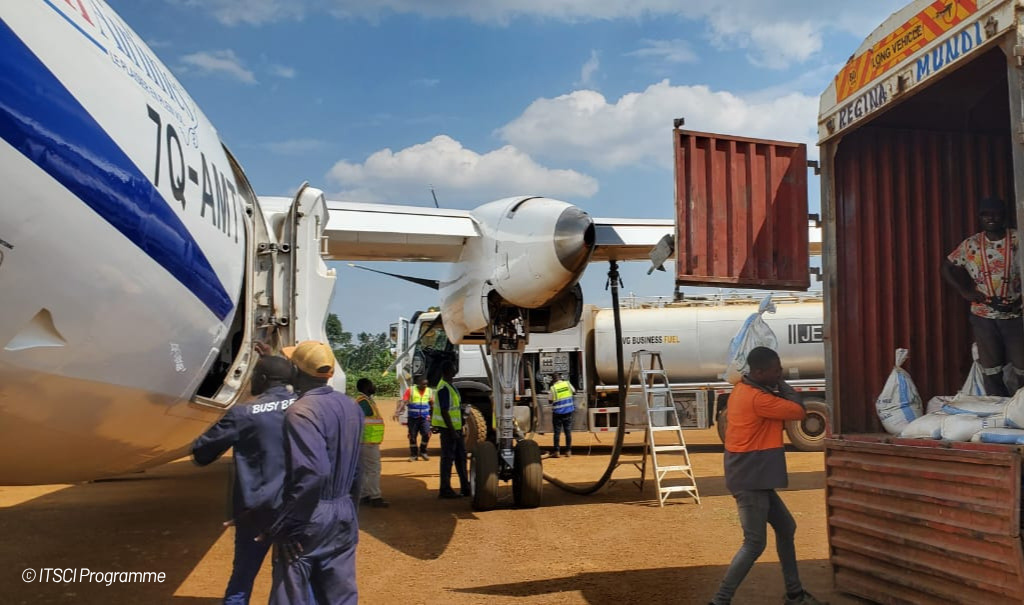
A shipment of minerals arriving at Mavivi Airport, Beni territory, August 2026
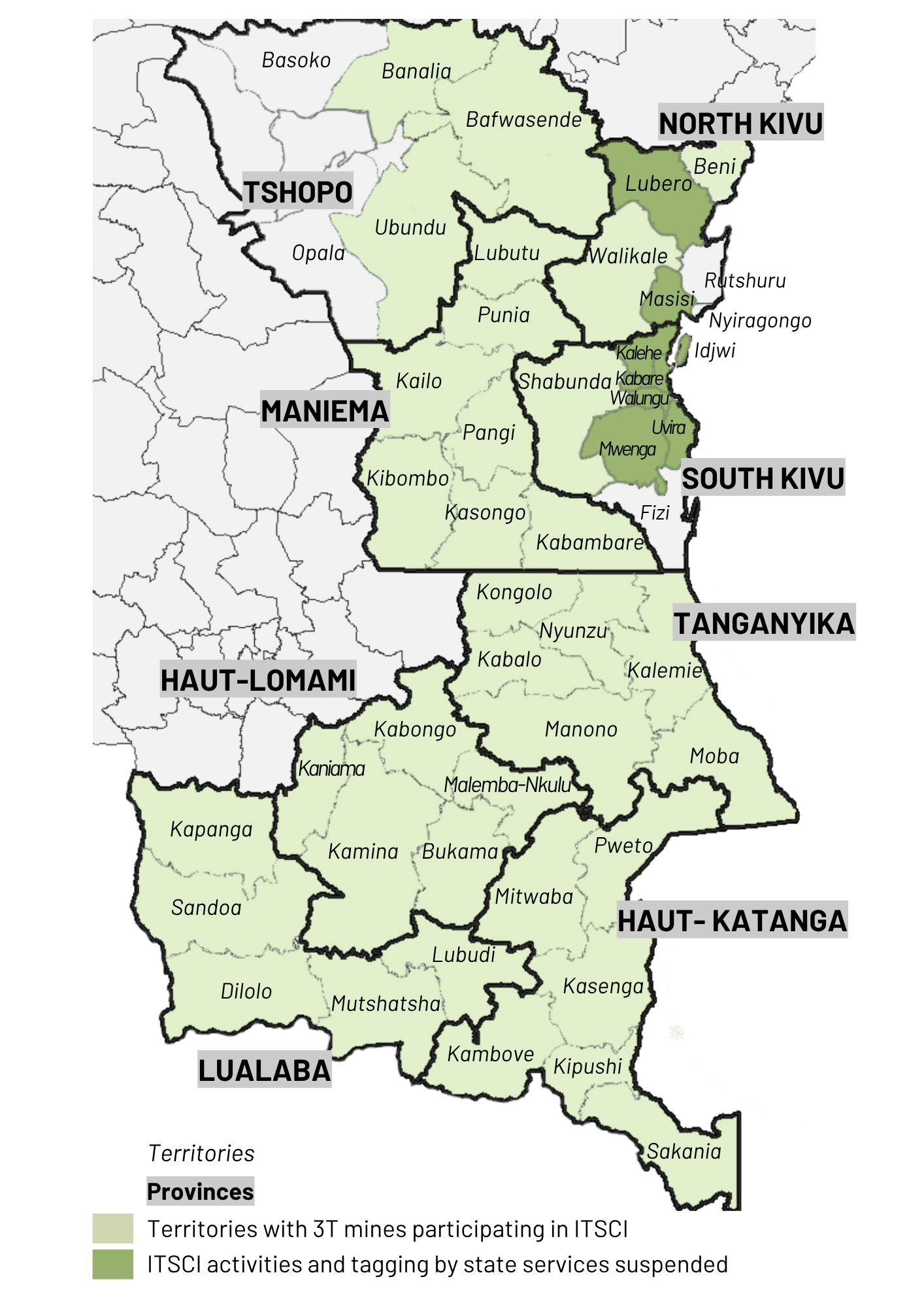
Overview of ITSCI activities suspension in Eastern DRC
For more details, please see our previous updates at the end of this statement.
Walikale Territory
ITSCI activities, including monitoring by our on-the-ground teams and tagging by state services are taking place normally in Walikale territory, including in the trading towns of Walikale and Lubero since June 2025. Mine sites located at the border with Masisi territory remain suspended due to the heightened risks in that area.
Masisi Territory
All ITSCI activities, including tagging by state mining services, remain suspended throughout Masisi territory. The territory, including the trading town of Rubaya and surrounding areas, remains under the control of the M23/AFC non-state armed group.
Lubero Territory
All ITSCI activities remain suspended in Lubero territory. Security concerns persist due to the presence of multiple non-state armed groups, including M23, ADF-Nalu and various Wazalendo groups, including in areas where ITSCI previously monitored 3T mining activities.
South Kivu Province
The situation in Kabare, Kalehe, Idjwi, Mwenga, Uvira and Walungu territories remains unchanged, with ITSCI monitoring activities and tagging by state services suspended. In Shabunda territory, activities continue. These include close monitoring by ITSCI field teams of the security situation and associated risks, tagging by state services, the discussion of risks at local multi-stakeholder committees, and ITSCI support and guidance to mitigate those risks.
Ongoing risks and collective responsibility
We remain very concerned by the serious security and humanitarian situation in eastern DRC and its impact on affected communities. We continue to closely follow developments, while also calling for a peaceful and diplomatic resolution of the conflict by all parties.
The prolonged suspension of ITSCI monitoring and tagging by state services in areas of North and South Kivu Provinces has had wider implications, including high risks of illegal taxation and mineral fraud. In this context, ITSCI has published a statement on 3T mineral flows from the Great Lakes Region, including data relating to material traded outside the ITSCI Programme, to help stakeholders understand how insecurity and the suspension of traceability, due diligence and state oversight leads to heightened risks and discrepancies between production, export, and international trade figures.
This statement supports responsible sourcing and companies’ due diligence by highlighting the effective actions undertaken by ITSCI to address those risks. Companies sourcing minerals from affected regions should continue to engage proactively with suppliers, assess potential impacts on their supply chains, review risk management systems and implement any additional measures necessary to address risks.
Current Ebola outbreak
In addition to conflict-related challenges, communities in eastern DRC are also facing the impacts of the most severe Ebola outbreak to date. Cases have been confirmed in several provinces, including North and South Kivu. We are profoundly saddened by the suffering caused by this outbreak, including the many lives already lost, and stand in solidarity with affected families and communities. While no cases have been reported at ITSCI-monitored mine sites, ITSCI continues to work closely with its field teams, state services and local stakeholders to support awareness-raising efforts, promote reliable public health information and encourage appropriate prevention measures during regular engagements with mining communities.
Find out more in our latest statement: Supporting community awareness during Ebola outbreak.
– END –
ITSCI is committed to record and follow-up all information received regarding supply chain risks and encourages all parties to use our whistleblowing programme to report any risks or incidents, for us to continue reporting and advocating for appropriate actions. The ITSCI whistleblowing procedure and contact details are available online at www.itsci.org/contact/. The confidential ITSCI whistleblowing address is [email protected].
Contact us
Contact us at [email protected]
For media enquiries, contact [email protected]
Previous publications on this topic
UPDATED ITSCI statement: Shifts in tantalum mineral flows from the Great Lakes Region (February 2026)
ITSCI statement on the mine collapse in Rubaya, Masisi territory (February 2026)
ITSCI statement: Shifts in tantalum mineral flows from the Great Lakes Region (November 2025)
Ongoing situation in North and South Kivu Province, DRC (September 2025)
ITSCI welcomes the peace agreement between the DRC and Rwanda (July 2025)
Recent Developments in North and South Kivu, DRC (April 2025)
ITSCI statement on the recent European Council sanctions (March 2025)
Update on the situation in North and South Kivu, DRC (February 2025)
ITSCI clarifies the role of its 3T traceability and due diligence Programme (February 2025)
Escalating security situation in North and South Kivu (January 2025)
ITSCI update on the security situation in North Kivu Province (January 2025)