
Following our previous statements on shift of tantalum trade from the Great Lakes Region (GLR) and following the release of the final report of the UN Group of Experts on the DRC submitted in accordance with paragraph 6 of resolution 2783 (2025) and published on 5 June 2026[1], we are providing updated data on tin, tantalum, and tungsten (3T) mineral trade recorded by ITSCI in Rwanda. This statement also provides useful context for information contained in the UN Group of Experts’ report as it relates to ITSCI-monitored mineral supply chains, and is part of our ongoing commitment to transparency and responsible sourcing.
We remain very concerned by the serious security and humanitarian situation in eastern DRC and its impact on local populations. We continue to closely follow developments in the conflict; while also calling for a peaceful and diplomatic resolution of the conflict by all parties.
While this situation continues to have a severe impact on local communities, including forced displacement, violence and human rights abuses, we continue to take all possible measures within our mandate to support local stakeholders and make good faith efforts to address risks. This includes implementing measures and risk control mechanisms in ITSCI-monitored supply chains to support responsible sourcing and help avoid any broad, undifferentiated and harmful embargo on 3T minerals from the GLR.
ITSCI-monitored vs. non-ITSCI supply chains in Rwanda
We are sharing the data below to support understanding of ITSCI-monitored supply chains in Rwanda and to promote enhanced due diligence practices of companies sourcing from the region.
This statement provides an overview of ITSCI-recorded exports of 3T minerals, compared with two other datasets: international trade data of 3T minerals world imports from Rwanda; and official export data from the National Bank of Rwanda (NBR). The graphs should be read together with the associated explanatory comments, including on data limitations.
We emphasise again that not all 3T operators in the Great Lakes Region participate in ITSCI and ITSCI does not report on non-ITSCI tonnages. The data provided below demonstrates that a significant portion of 3T minerals mined and exported from Rwanda are not traced or monitored by the ITSCI Programme.
General overview of 3T trade data
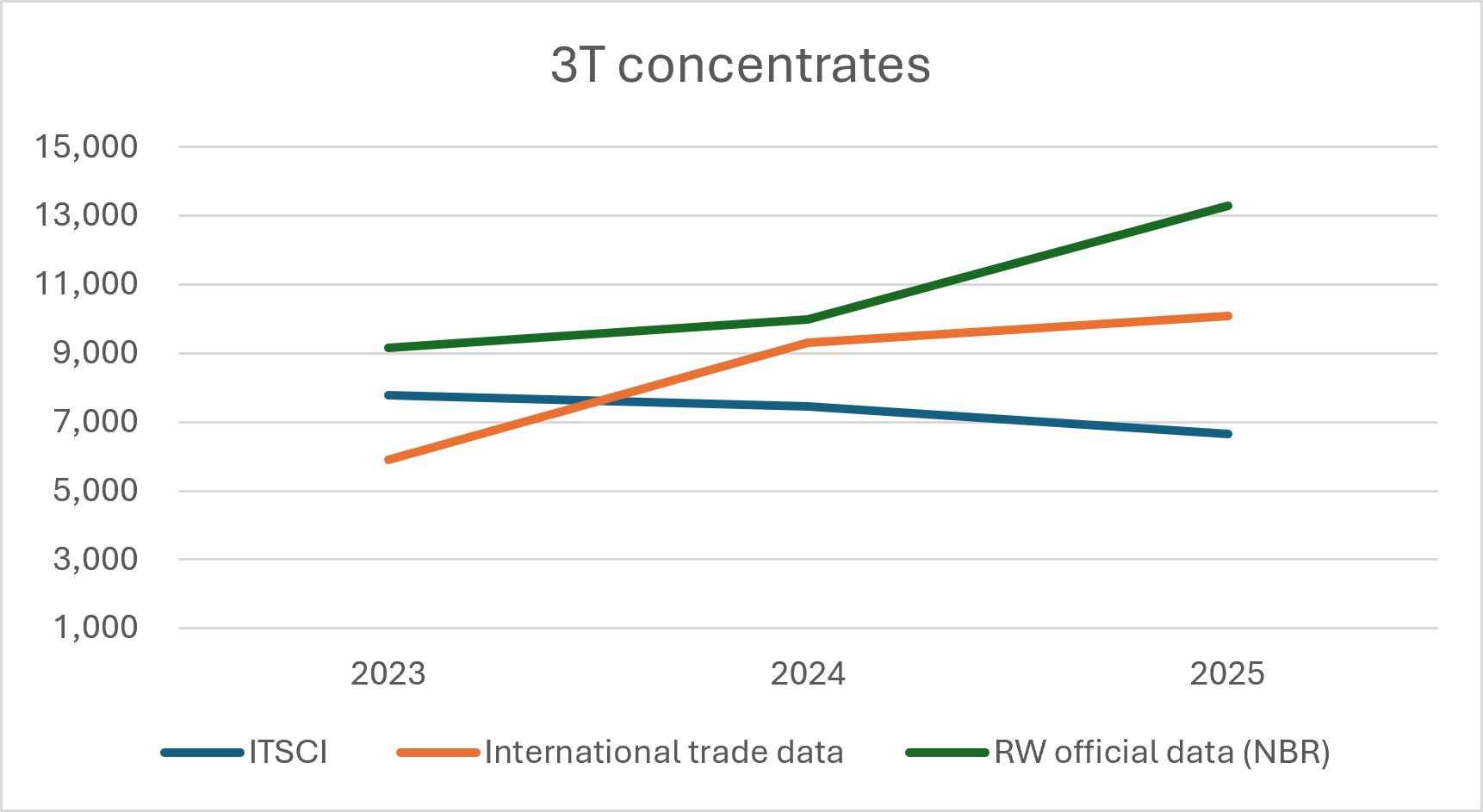
Overall, 3T exports from Rwanda recorded in ITSCI-monitored supply chains remained at similar levels to those seen over the past years, within variations typically seen and expected year-on-year. Multiple factors can lead to continual variations – whether increase or decrease – in mining activities on the ground, including investments, international mineral prices, regulatory changes, local compliance requirements, among others.
In 2025, ITSCI-recorded exports from Rwanda decreased for the combined total of 3T minerals exports compared with 2024, with a total of 6,646 tonnes of 3T mineral exports recorded by ITSCI, a variation of -11% or -817 tonnes compared to 2024.
At the same time, official Rwandan export data from the National Bank of Rwanda (NBR) increased by 33% (+3,308 tonnes) in 2025 reaching a total of 13,295 tonnes, thus showing substantially higher 3T export volumes for 2025 than those recorded in ITSCI. Based on official NBR data, ITSCI-recorded trade represented around 50% of Rwanda’s official 3T exports in 2025. The same trend appears to continue based on available 2026 Q1 data.
This evidence clearly demonstrates that any analysis of variations in Rwanda’s 3T exports cannot be credibly limited to ITSCI-recorded supply chains alone. Not all mine operators, exporters, processors or smelters in the region participate in the ITSCI Programme. Other systems implemented by third party providers or local mining operators, including smelters, are also operating in-region. These systems appear to reflect different transparency practices and would therefore benefit from further information disclosure to align with transparency expectations such as those applied by ITSCI.
Information from the Group of Experts’ and other public reports note that mineral fraud into Rwanda increased overall in 2025. Risk information collected and reported by ITSCI appears to be consistent with this assessment. As demonstrated above, such increase is not visible in ITSCI-recorded export data. A fuller explanation therefore requires review of the wider market and additional datasets, including non-ITSCI operators and non-ITSCI-recorded trade. Further comment is provided below for each mineral type – tin, tantalum, and tungsten.
Tin concentrates & metal data
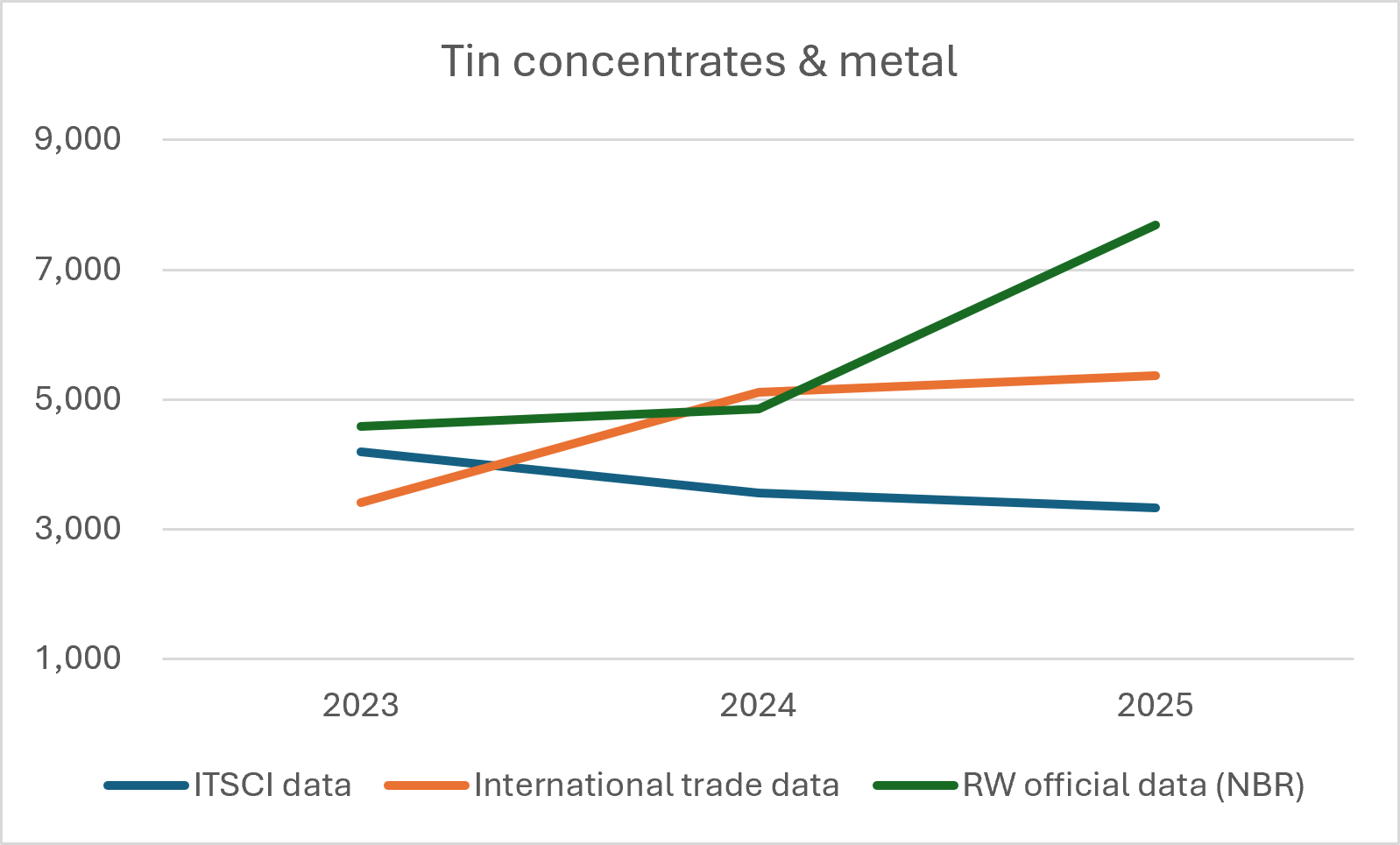
- The trade data in this chart includes global imports from Rwanda of both tin concentrates (ores) and tin metal (smelted ingots).
- The 2025 UN Group of Experts’ final report quotes figures from the NBR and notes that “Rwanda’s cassiterite exports increased by 58% in 2025, from 4,859 to 7,700 tonnes”[2].
- The UN Group of Experts’ report also notes that a non-ITSCI smelter operates in Rwanda. We assume that NBR data shown above include the export of tin metal from that smelter. Public reports from that the smelter show a 74% increase in metal output between 2023 and 2025.
- ITSCI-recorded cassiterite exports from Rwanda, with a total of 3,326 tonnes, are far below the figures quoted by the UN Group of Experts, even showing a decrease by 6% (-228 tonnes) in 2025 compared with 2024.
- While ITSCI-recorded cassiterite exports from Rwanda decreased, NBR and international trade data – both of which include non‑ITSCI minerals – showed an increase over the past two years, thereby widening the gap with ITSCI data.
Tantalum concentrates data
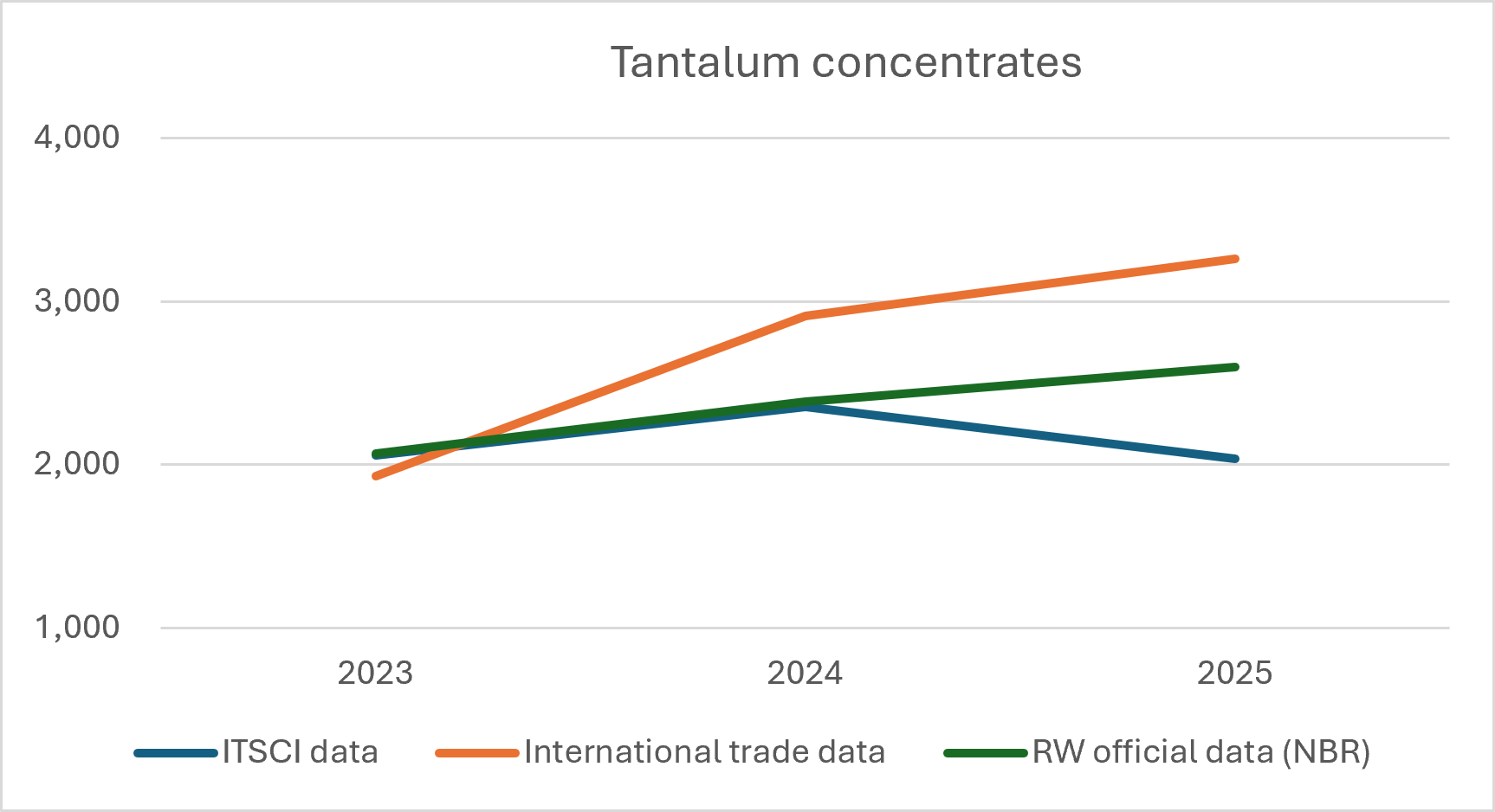
- This graph complements previous ITSCI publications on tantalum mineral flows from Rwanda, illustrating continued overall increase in tantalum exports as shown by the NBR and international trade data, which include non-ITSCI minerals and are well above the level of tantalum exports from ITSCI-monitored supply chains.
- Compared with 2024, ITSCI-recorded tantalum exports in 2025 decreased by 13% (-316 tonnes).
- On the opposite, NBR and international trade data, which include both ITSCI and non-ITSCI mineral volumes, show an increase of 9% (+212 tonnes) and 12% (+355 tonnes) respectively, both compared to 2024. As demonstrated by ITSCI data, these increases cannot be attributed to ITSCI-monitored supply chains.
Tungsten concentrates data
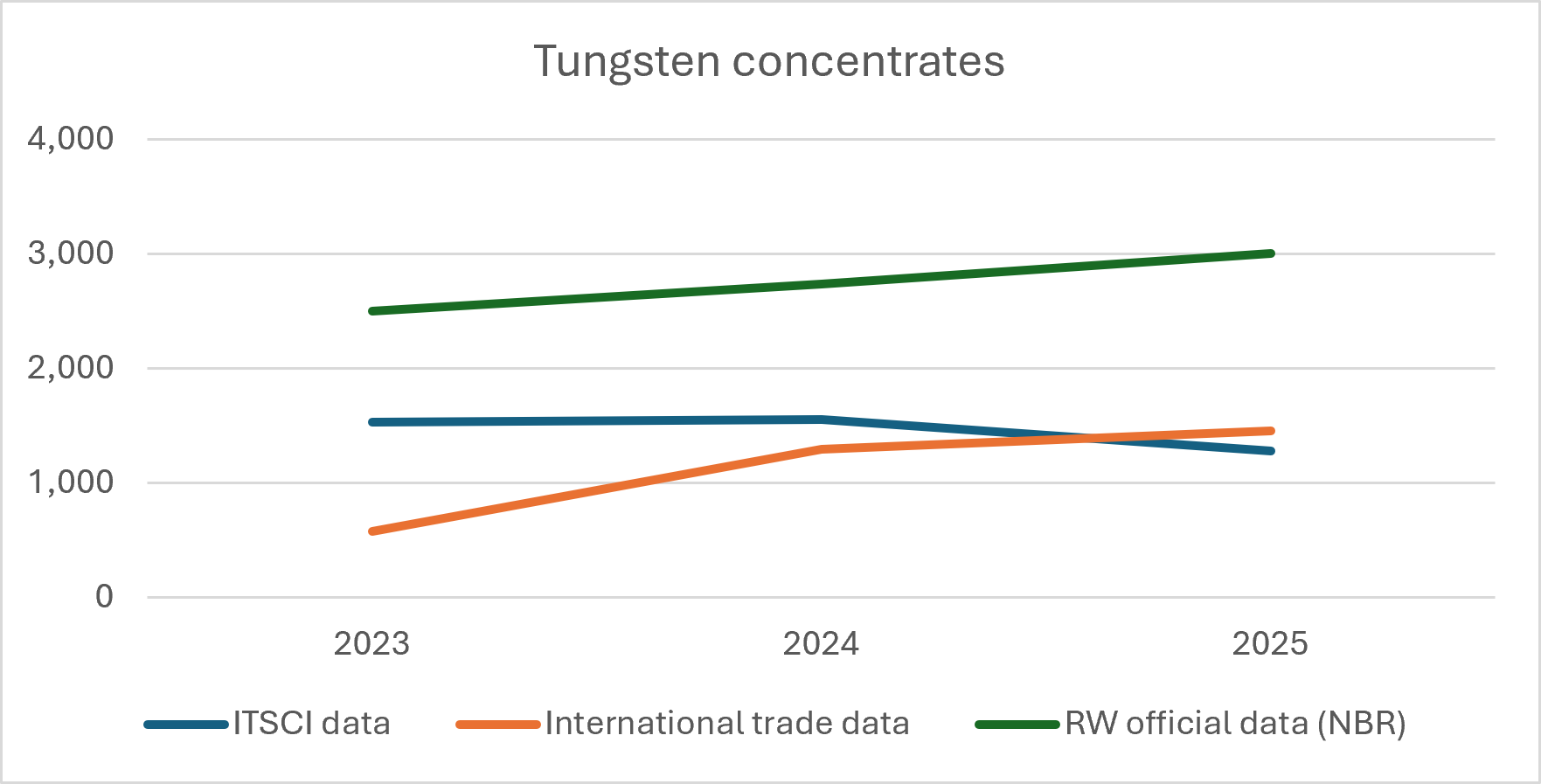
- ITSCI-recorded exports of tungsten concentrates remained at similar levels in the past two years, with a 18% decrease (-273 tonnes) recorded in 2025 compared to 2024.
- This figure contrasts with the data reported in both NBR and international trade data, both including ITSCI and non-ITSCI minerals volumes, and which show increases of 10% (+268 tonnes) and 13% (+166 tonnes) respectively in 2025, compared with 2024.
- As demonstrated by ITSCI data, these increases cannot be attributed to ITSCI-monitored supply chains.
- There are known limitations in available international trade data for tungsten, including the fact that certain countries do not declare tungsten imports for national security reasons. Such imports may therefore not be reflected in international trade datasets, which may explain the discrepancy between NBR and international trade data shown in above graph .
- There are no figures or comments on tungsten volumes in the UN Group of Experts’ final report mentioned above.
- Overall, ITSCI-recorded exports of tungsten concentrates from Rwanda represent less than 50% of total tungsten exports from Rwanda.
ITSCI actions to address high risks in mineral supply chains in Rwanda
ITSCI continues to acknowledge high risks of both internal fraud of domestic mined production within Rwanda, as well as cross-border fraud risks. ITSCI has therefore continued to take proactive actions to address these risks and to implement effective control mechanisms to evaluate mineral production plausibility as relevant to our operations.
In 2025, ITSCI suspended the distribution of traceability tools to several mining companies due to the absence of appropriate control mechanisms following those companies’ decision to use multiple traceability services. In order to reduce the risk of misuse of ITSCI traceability tools, ITSCI halted tag distribution to the concerned companies until satisfactory control processes were agreed. These actions contributed to the decrease in ITSCI-recorded production and exports, as shown in 2025 data above.
ITSCI continues to support responsible sourcing of minerals by providing due diligence recommendations to companies participating in the ITSCI Programme. ITSCI also maintains accountability of companies and has thus far suspended six local ITSCI Participant exporters – some of which are named in the UN Group of Experts’ report – due to failure to provide sufficient evidence of due diligence implementation.[3] High-risk incidents have also been recorded for additional Rwandan exporters, and ITSCI continues to evaluate relevant information in this regard, with the view of taking further actions where appropriate.
Collective Responsibility: a call to action and accountability across the supply chain
ITSCI remains deeply concerned about the high risks of cross-border mineral fraud. Multiple reports continue to point to inconsistent levels of due diligence compliance among local companies, undermining the integrity of responsible sourcing efforts and creating uncertainty for international companies sourcing from these regions. In response, ITSCI has proactively engaged with key stakeholders, calling on them to support and take concrete action to address these risks and strengthen oversight. ITSCI previously provided relevant contextual information with the UN Group of Experts. However, this information was not reflected in the Group’s most recent report.
ITSCI continues to advocate for OECD-aligned, consistent and transparent approaches to due diligence across the upstream mineral supply chain. All companies retain individual responsibility for due diligence including for evaluating the operations of systems they may rely on.
ITSCI is committed to record and follow-up all information received regarding supply chain risks and encourages all parties to use our whistleblowing programme to report any risks or incidents, for us to continue reporting and advocating for appropriate actions. The ITSCI whistleblowing procedure and contact details are available online at www.itsci.org/contact/. The confidential ITSCI whistleblowing address is [email protected].
[1] https://main.un.org/securitycouncil/en/sanctions/1533/panel-of-experts/expert-reports
[2] Final report of the Group of Experts on the DRC, 5 June 2026, paragraph 223, page 40.
[3] More details, including updates on ITSCI Programme Participants are available on ITSCI website: https://www.itsci.org/join-our-programme/participants-news/
***END***
Additional resources for more information
We appreciate the trust and support of our participating companies and partners. Any parties with concerns or questions about our Programme or its role are encouraged to contact us directly. We are committed to addressing any inquiries and maintaining open, honest communication. We would also like to encourage anyone interested in our activities to visit our website where public information showcases ITSCI’s years’ worth of insight including data on mine production and very positive developments and progress.
- Read our 2025 ITSCI Annual report including updates on continuous improvements.
- Read ITSCI Independent Alignment Assessment using the OECD methodology
- Read our updates on ITSCI Programme Participants news.
- Read our recent news:
Contact
Contact us at [email protected]
For media enquiries, contact [email protected]