
ITSCI is closely monitoring the ongoing outbreak caused by the Bundibugyo strain of the Ebola virus, which has had a significant impact on affected communities in parts of the Eastern Democratic Republic of the Congo (DRC). We are profoundly saddened by the suffering caused by this outbreak, including the many lives already lost, and stand in solidarity with affected families and communities. We recognise the efforts of health authorities, medical staff, and partner organisations working on the ground to contain the spread of the disease and support those affected.
Cases have thus far been confirmed in Haut-Uele, Ituri, North Kivu, South Kivu, and Tshopo Provinces. Among those provinces, the ITSCI Programme is currently present in North Kivu, South Kivu and Tshopo Provinces. ITSCI does not currently operate in Haut-Uele or Ituri Province.[1]
While no cases have been confirmed in ITSCI-monitored mines at this time, the outbreak has prompted some precautionary travel-related measures. In response to the evolving situation, we continue to work closely with our field teams and state services to help support local stakeholders and mining communities.
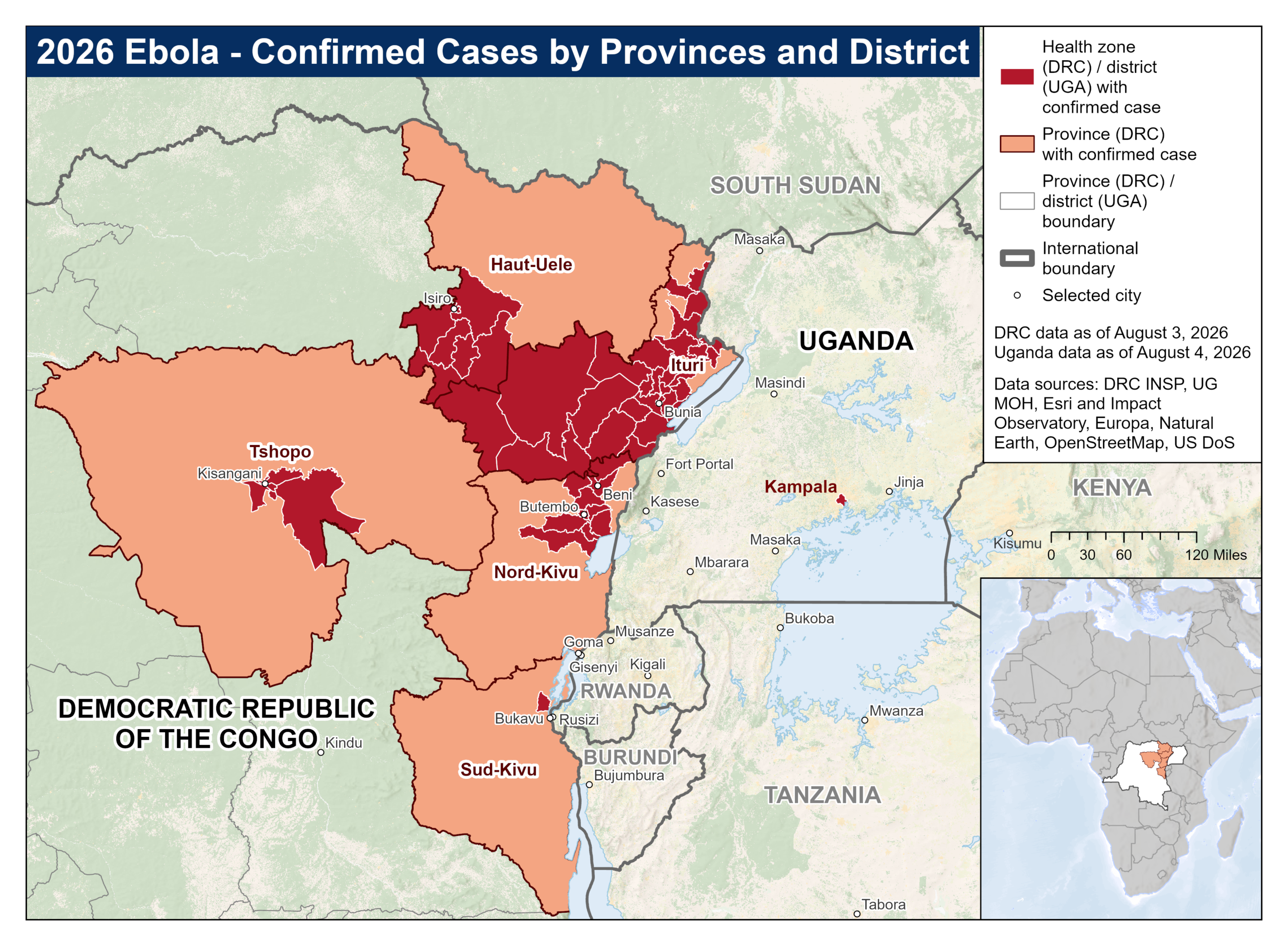
Map of affected areas: https://www.cdc.gov/ebola/situation-summary/index.html
As a Programme working alongside mining communities, ITSCI recognises that such outbreaks can create concerns that extend beyond public health. They can disrupt livelihoods and economic activity, generate misinformation and fear, and increase the risk of discrimination against communities or individuals. Responsible communication and community engagement are therefore essential for concerns to be addressed with accurate information and proportionate precautionary measures.
As part of this approach, following guidance issued by the World Health Organisation (WHO) and DRC national authorities, ITSCI developed awareness-raising guidance shared with all ITSCI on-the-ground teams to ensure a common understanding of the outbreak, the associated risks, and the recommended prevention measures. This helps maintain a consistent approach across the ITSCI Programme and ensures that staff are equipped with accurate and up-to-date information.
Using this guidance, ITSCI teams are engaging with local stakeholders to promote good prevention practices and support the dissemination of reliable information during regular visits at and around ITSCI-monitored mine sites. So far, ITSCI field teams have conducted 19 awareness-raising sessions on the outbreak with state mining services (SAEMAPE, Divimines), and mining operators such as artisanal and small-scale miners, mining cooperatives, local negociants, and exporters have been conducted by ITSCI field teams in North Kivu and Maniema Provinces.
Particular emphasis is placed on avoiding misinformation, stigmatisation or discrimination against individuals or communities that may be perceived to be linked to affected areas. Awareness-raising activities are added to our regular stakeholder engagements, including multi-stakeholder committee meetings facilitated by ITSCI at local and provincial level (Comité Local (CLS) et Provincial (CPP) de Suivi), helping to reinforce public health messages and encourage responsible preventive measures aligned with the latest WHO advice and national public health guidance.
[1] The ITSCI Programme operates in eight Provinces in the DRC including Haut-Katanga, Haut-Lomami, Lualaba, Maniema, North Kivu, South Kivu, Tanganyika, and Tshopo Province, with activities suspended in some territories due to the current conflict related to M23/AFC non-state armed group: About iTSCi – ITSCI
Contact us
Contact us at [email protected]
For media enquiries, contact [email protected]
About the ITSCI Programme
ITSCI monitors 3,064 artisanal and semi-mechanised mine sites in the Great Lakes Region, including 1,693 in the DRC. Artisanal and small-scale mining is a vital source of livelihood for many local communities across the DRC and the broader Great Lakes Region. ITSCI supports 88,367 artisanal miners currently working in ITSCI monitored mine sites including by providing guidance and training and by addressing challenges though a collaborative, risk-based approach that upholds responsible mining, therefore delivering tangible benefits to local communities.
One core aspect of ITSCI has been to support the establishment of local and provincial multi-stakeholder committee meetings and to provide capacity-building training for local committee members. More than 90 committees (CLS and CPP) are now facilitated by ITSCI in the DRC, demonstrating the relevance and sustainability of this approach. Find out more in our latest annual report: https://www.itsci.org/reporting/.